
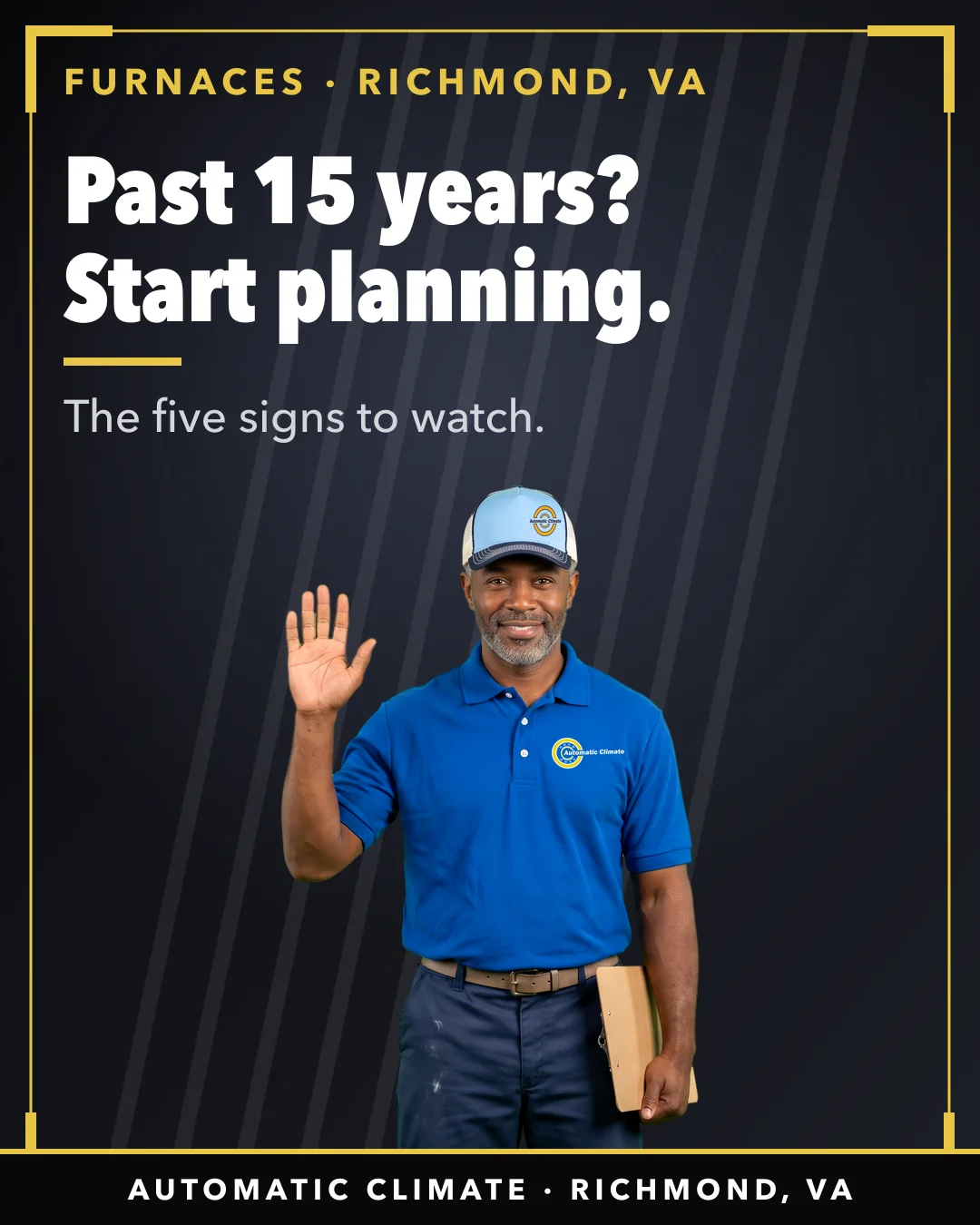
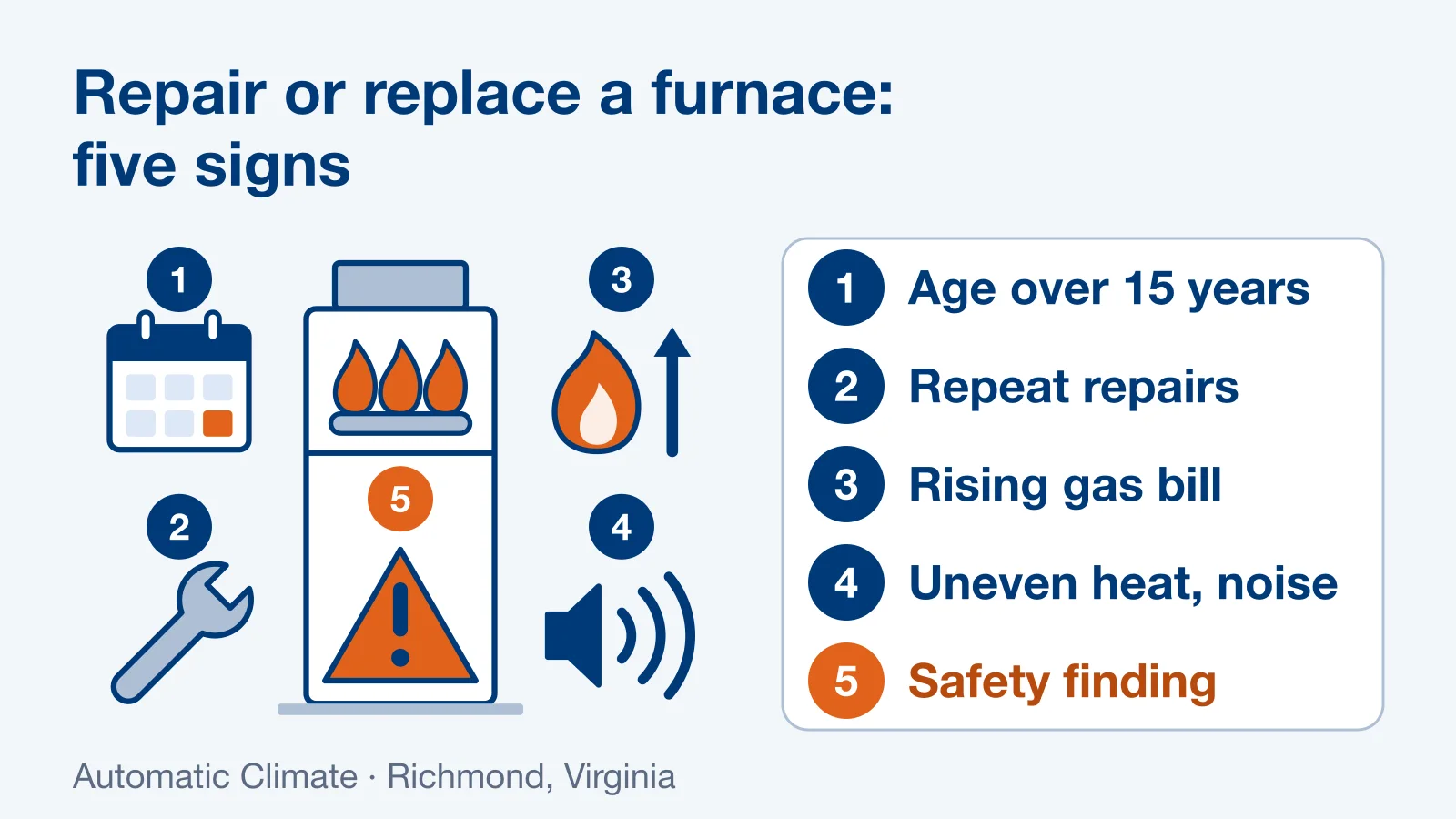
Deciding when to replace a furnace comes down to five signs: its age, repairs that keep coming, a gas bill rising for the same use, uneven heat or new noise, and a safety finding. ENERGY STAR says to consider replacing a furnace that is more than 15 years old. Age by itself is a reason to plan. Age plus another sign is the time to replace, and one failed part on a younger furnace is a repair.
Key takeaways
- ENERGY STAR says to consider replacing a furnace that is more than 15 years old.
- Age by itself means plan. Age plus another sign means replace.
- One failed part on a younger furnace is a repair.
- Uneven rooms and airflow noise often trace to the ducts, so check those first.
- A cracked heat exchanger or carbon monoxide traced to the furnace means it stays off until it is repaired or replaced.
Sign 1: How old is the furnace?
Age is the first sign and the easiest to check: the manufacture date is on the data plate inside the furnace door. An old furnace that still runs well can stay, and its age is the reason to start planning and budgeting for the next one.
The US Department of Energy gives a furnace a life expectancy of 15 to 30 years, and the Department of Energy‘s cost comparisons assume an average residential furnace lifetime of 21 years. ENERGY STAR’s mark for considering a replacement sits at the bottom of that range, so it is the start of the window, and the other four signs decide what happens inside it.
To find the age, switch the furnace’s power off and open the upper door. The data plate lists the model and serial number, and often the manufacture date. Where no date is printed, the serial number encodes it, and the manufacturer or a technician can decode it. A pilot light that burns all the time is its own answer: that furnace belongs to the oldest and least efficient generation.
Sign 2: Is the furnace needing repairs more often?
Repairs become a sign when they form a pattern: different parts failing in back-to-back winters, or a major part failing on a furnace that is already old. One failed part on a younger furnace is simply a repair.
ENERGY STAR pairs frequent repairs with rising energy bills as one sign that equipment may have become less efficient. To check the repair half, pull out the invoices and look at what was replaced.
An igniter, a flame sensor, a capacitor or a pressure switch is an ordinary part that wears out once and gets replaced. A blower motor or a control board costs more and is still a sensible repair on a furnace with years ahead of it. The pattern looks different: the inducer motor one winter, the control board the next, the gas valve after that. Each repair made sense on the day. Together they describe a furnace wearing out one part at a time.
A furnace that has simply stopped is a separate question, and often a small one. Our furnace reset button guide covers the one safe restart to try first.
Sign 3: Is the gas bill rising for the same use?
A rising gas bill points at the furnace only when the use is the same. Compare the therms on this winter’s bill with the same month last year, because the price of gas and the weather both change the dollar total.
Rule out the cheap causes first: a clogged filter, a return grille blocked by furniture, a duct that has come apart in the crawl space or attic, a thermostat schedule someone changed. Any of those makes a healthy furnace run longer.
Then find out which generation of furnace you have. The US Department of Energy puts old, low-efficiency heating systems at 56% to 70% AFUE, against 80% to 83% for mid-efficiency systems, with high-efficiency systems reaching 90% to 98.5%. AFUE is the share of the fuel that reaches the house as heat. Most of the rest goes up the flue.
A standing pilot and a wide metal flue mark the low-efficiency generation. A small fan on a metal flue marks mid-efficiency, and plastic vent pipes mark high-efficiency. Replacing a low-efficiency furnace changes the gas bill in a way no repair can. A mid-efficiency furnace in good health is a different case, because the step up to a new one is smaller.
A new gas furnace of the usual indoor kind has to be at least 80% AFUE under the federal standard in the eCFR, and that floor rises to 95% for furnaces manufactured on or after December 18, 2028. Furnaces built after that date will all be the high-efficiency kind.
Sign 4: Are rooms heating unevenly, or is the furnace louder?
Uneven rooms and new noise are signs to investigate before they are signs to replace. The cause can sit in the ducts or the insulation, which are cheaper to fix than a furnace, and most furnace noises trace to a single part.
ENERGY STAR lists rooms that are too hot or too cold as a sign and gives three possible causes: improper equipment operation, duct problems or inadequate insulation. For a noisy system it points to an undersized duct system or a problem with the indoor coil. So start with the ducts. Our guide to air that does not reach every room evenly walks through those checks.
Some noises do come from the furnace, and most of them are parts. A boom when the burners light is delayed ignition, usually from dirty burners, and it needs attention soon. A squeal or a grinding sound from the blower compartment is a motor bearing. A rattle that starts with the small fan on the flue is the inducer.
The furnace itself is the cause when it is too big for the house. An oversized furnace heats the nearest rooms fast, satisfies the thermostat and shuts off before the far rooms catch up. The US Department of Energy lists oversizing, poorly designed distribution systems and leaky ducts as installation problems that bring discomfort and shorter equipment life. No repair changes a furnace’s size. Sizing is corrected at replacement, with a furnace chosen from a heat-load calculation for the house.
Sign 5: Has a technician found a safety problem?
A safety finding outranks the other four signs. A cracked heat exchanger, flames rolling out of the burner compartment, or carbon monoxide traced to the furnace means the furnace stays off until it is repaired or replaced, whatever its age.
The heat exchanger is the metal wall between the flame and the air that goes to your rooms. When it cracks or rusts through, combustion gases can reach that air. From the outside you can see flames that waver or lift when the blower starts, soot or scorch marks around the burner compartment, or a rollout switch that has tripped. The crack itself takes an inspection camera or a mirror and a trained eye, so ask to be shown the picture.
Carbon monoxide has no smell and no color. The US Consumer Product Safety Commission says to install carbon monoxide alarms on every level of the home and outside sleeping areas, and to have the heating system professionally inspected and serviced every year. If an alarm sounds, the Commission’s instruction is to move outside to fresh air immediately and call 911 or the fire department. A furnace found to be the source stays off until trained personnel have serviced it. If you smell gas, leave the house and call the gas company or 911 from outside.
After a finding, the choice is still repair or replace. A heat exchanger can be replaced on many furnaces, and it is often covered by a longer warranty than the other parts, so find the paperwork first. On a furnace already past the age mark, a new heat exchanger goes into a cabinet whose other parts are just as old, and replacement is the usual answer.
How do you decide when to replace a furnace?
Start with safety, then count the signs. A safety finding decides the matter on its own. Otherwise, one sign on a furnace that is not yet old calls for a repair. Age plus another sign, once the filter and the ducts are ruled out, is the point where the next repair bill is better spent on a new furnace.
Repair is the right call when the furnace is younger than the ENERGY STAR mark, the failed part is a single ordinary one, the gas use is steady and the house heats evenly. Repair is also right at any age when the complaint turns out to be a duct, a filter or a thermostat.
The case in between is the old furnace that runs well and shows nothing else. Keep it, have it inspected every year, and get a replacement priced before you need one. A furnace replaced on your schedule is sized and installed with care. One replaced the day it fails is chosen in a hurry. When the signs do say replace, our heating system replacement page is the place to start.
Repair or replace: find your case
| Topic | What it usually means | What to do |
|---|---|---|
| A newer furnace with one failed part | An ordinary part has worn out | Repair it |
| An older furnace that runs well | Age is the only sign | Keep it, inspect it every year, and get a replacement priced |
| An older furnace repaired in back-to-back winters | The furnace is wearing out one part at a time | Replace it on your schedule |
| A pilot-light furnace that needs a major part | The low-efficiency generation, near the end | Replace it |
| Gas use up, furnace otherwise healthy | Often a filter, a duct or a thermostat schedule | Fix the cause, then compare the therms again |
| Uneven rooms or airflow noise | Often ducts or insulation, sometimes an oversized furnace | Check the ducts first. Sizing is corrected at replacement |
| A safety finding at any age | A cracked heat exchanger, flame rollout or carbon monoxide | The furnace stays off until it is repaired or replaced |
Find your furnace in the first column. Older means past the age ENERGY STAR flags.
Does a Richmond winter change the answer?
A Richmond winter is shorter and milder than a northern one, so a furnace here runs fewer hours and a more efficient one saves less gas each year. Around Richmond the case for replacing rests on age, repairs and safety before efficiency.
NOAA‘s climate normals put Richmond International Airport at about 3,700 heating degree days a year, against about 6,000 at Chicago O’Hare. Heating degree days measure how much heating a place needs over a year.
The US Department of Energy works that difference into its purchasing guidance: the same 70,000 Btu/h furnace at 80% AFUE uses 621 therms a year in its Northern Region and 360 therms a year in its Southern Region, which includes Virginia. In the Department of Energy‘s Southern Region example, a 90% AFUE furnace uses 320 therms a year, against 360 for the 80% model. The saving is real, and it is small.
Many Central Virginia homes heat with a heat pump and keep a gas furnace as the backup for the coldest hours. A backup furnace runs far fewer hours than one carrying the whole winter, so judge it by its condition and its repair record more than its birthday.
Where the backup is electric heat strips inside an air handler, there is no burner, no heat exchanger and no flue, and the system to watch is the heat pump. ENERGY STAR says to consider replacing a heat pump that is more than 10 years old. If the air from the vents feels cool in winter, see our guide to a heat pump blowing cool air.
Frequently asked questions
Should I replace the air conditioner when I replace the furnace?
Not automatically. The two share the blower, and the cooling coil sits on the furnace, so doing both at once saves a second round of labor and lets the parts be matched. If the air conditioner is much newer than the furnace and cooling well, keep it, and have the installer confirm that the new furnace's blower suits it.
What changes if I move up to a high-efficiency furnace?
A high-efficiency furnace is a condensing furnace. It takes extra heat out of the exhaust, so the exhaust leaves cool and wet through plastic pipe to an outside wall or the roof, and the furnace needs a drain for the water. Replacing a standard furnace with one means new vent piping and a drain as well as the furnace itself.
Does regular maintenance make a furnace last longer?
Yes. The US Department of Energy says periodic maintenance can extend the life of a heating system and limit its loss of efficiency. The basics are a clean filter, open vents and returns, and a yearly visit that cleans and adjusts the burners, cleans and checks the flue, and checks the blower, the temperature rise and the high limit control. Small faults get caught before they become large ones.
What should I ask before I agree to replace a furnace?
Ask to see the evidence: the picture of the crack, the combustion reading, the repair history. Ask for the repair price beside the replacement price, and how the new furnace was sized. In Virginia, HVAC contractors are licensed by the Board for Contractors at the Department of Professional and Occupational Regulation, and you can look a license up on the DPOR website.
Should I switch to a heat pump when the furnace is replaced?
Price both. A heat pump heats and cools with one system, and Central Virginia winters are mild enough for one to carry most of the heating season. Pairing a heat pump with a gas furnace for the coldest nights is called dual fuel. The better choice depends on your gas and electric rates, your ducts and the age of your air conditioner.
What Automatic Climate checks before recommending a new furnace
A recommendation to replace a furnace should rest on readings. We start at the data plate, which gives the furnace's age, its size and its rated temperature rise, and we read the fault history stored on the control board. We inspect the heat exchanger and watch the burner flames as the blower starts. We test the exhaust for carbon monoxide and check that the flue is drawing. Thermometers in the supply and return air give the temperature rise, and a manometer gives the gas pressure and the static pressure in the ducts. Then we put the repair and the replacement side by side, so the decision is yours.
- Read the data plate and the control board's fault history
- Inspect the heat exchanger and watch the flames as the blower starts
- Test the exhaust for carbon monoxide and check the flue
- Measure temperature rise, gas pressure and duct static pressure
- Size a replacement to the house, not to the old furnace's label
Repair it or replace it?
Tell us the furnace's age, what has been repaired and when, and what you have noticed. We will inspect it and lay out both options, the repair and the replacement, so you can choose.
Sources
This guide was prepared for Automatic Climate with AI assistance.