


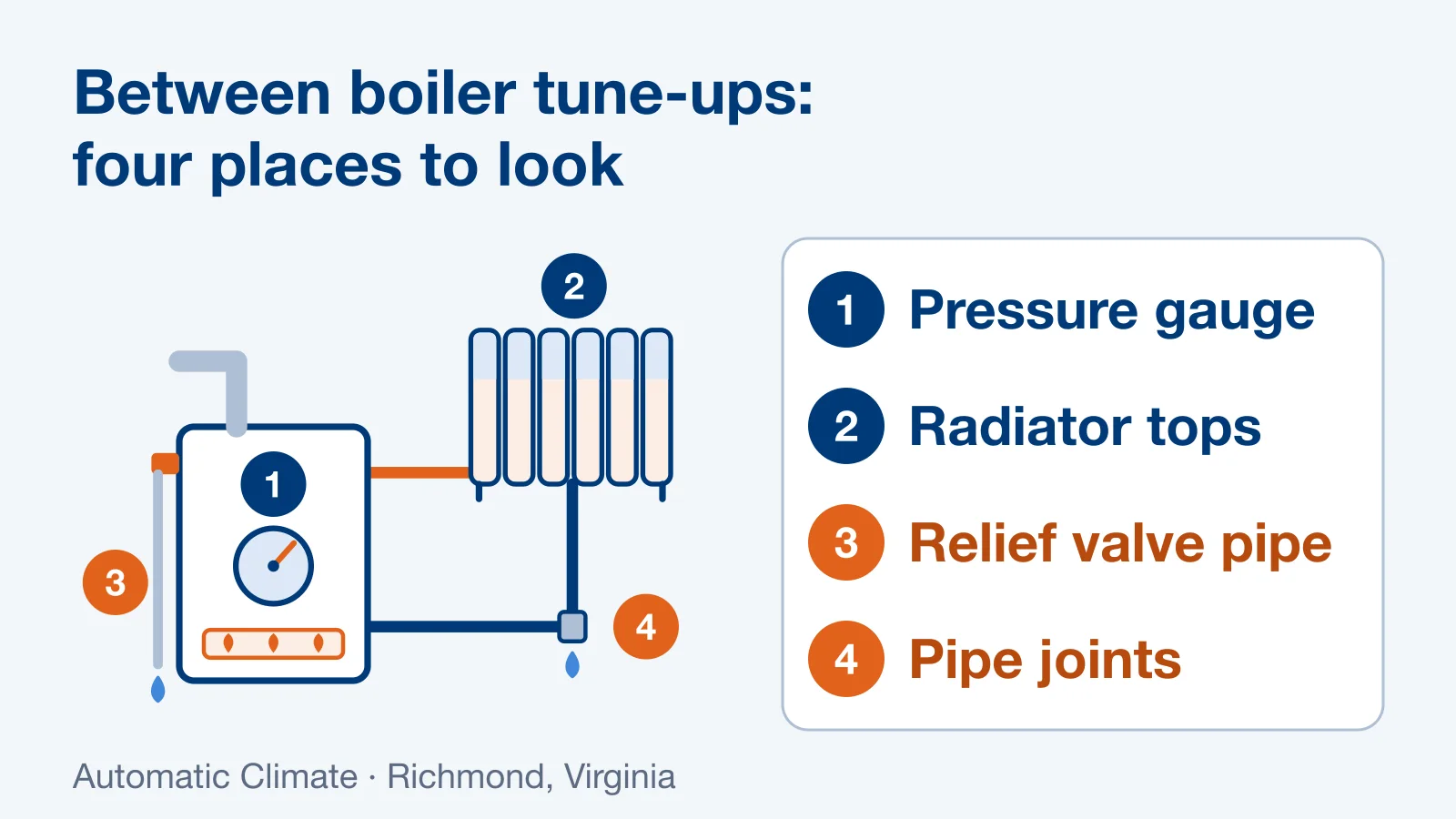
A hot-water boiler tune-up is a yearly visit in which a technician checks the boiler water pressure, the expansion tank, the circulator pump and the temperature and pressure relief valve, cleans the burners, removes trapped air from the radiators, and checks for gas leaks and carbon monoxide. Have one each year before the heating season. Between visits, watch three things: the pressure gauge, radiators that stay cold at the top, and water around the boiler.
Key takeaways
- A hot-water boiler tune-up is a yearly visit, best had before the heating season.
- Between visits, watch the pressure gauge, radiators that are cold at the top, and water around the boiler.
- A gauge reading that drifts, a dripping temperature and pressure relief valve or a boiler that shuts itself off needs a technician.
- Gas smell: leave and call the gas utility or 911. Carbon monoxide alarm: get outside and call 911.
What does a hot-water boiler tune-up include?
A hot-water boiler tune-up looks at the water side, the circulator pump and controls, the burners, the flue pipe, the radiators and the electrical connections. Our tune-up follows the company’s own hot-water boiler checklist, and the list is the same for every brand of boiler.
The table below is that checklist, grouped by part of the system. A few of its names need a word of explanation. The expansion tank gives the water room to expand as it heats. The water make-up valve feeds water in to hold the pressure, and the backflow preventer keeps boiler water out of the house’s drinking water. The aquastat is the control that sets the boiler’s water temperature. The circulator pump moves the heated water out to the radiators and back, and its amp draw shows how hard the motor is working.
We also review any comfort concerns with you, give an overall system condition rating with recommendations, and do a final walk-through. Boilers are part of our heating services, and when we install a new boiler we normally install Burnham.
What we check on a hot-water boiler tune-up
| Part of the system | What we check |
|---|---|
| Water side | Boiler water pressure; expansion tank condition; the water make-up valve; the backflow preventer; the temperature and pressure relief valve; accessible water lines for condition and leaks; the system’s water is tested |
| Circulator and controls | Circulator pump operation and amp draw; the aquastat, confirmed set to the correct temperature; thermostat operation |
| Radiators | Radiators free of air, trapped air removed and the radiators balanced; air vents, including auto vents, operating properly and not leaking |
| Burners and gas | Burners cleaned; the burners and the safety controls checked; a check for gas leaks; a check for carbon monoxide |
| Flue pipe | Properly supported; proper clearance from combustibles; sealed and free of leaks; free of rust and deterioration; proper slope |
| Electrical | Disconnect condition; electrical connections tight and secure |
| With the homeowner | Any comfort concerns reviewed; an overall system condition rating with recommendations; a final walk-through |
The company’s own hot-water boiler checklist, grouped by part of the system.
When should you have a boiler tune-up?
Have a boiler tune-up once a year, before the heating season. In the Richmond area that means September or early October, while the boiler is still resting and the first cold night is weeks away.
The yearly interval comes from the maker and from the safety agency. U.S. Boiler’s manual for the Burnham Series 3 says inspection and service should be conducted annually, and the US Consumer Product Safety Commission says to have a heating system professionally inspected and serviced annually.
The season turns quickly here. Richmond’s normal daily low falls from 49.0°F in October to 38.8°F in November, according to NOAA’s climate normals for Richmond International Airport. Richmond averages about 20 days in January with a low of 32°F or colder, according to NOAA. A boiler that stops on one of those nights is more than a comfort problem: U.S. Boiler’s manual warns that pipes may freeze when a boiler is out in winter.
If the season is already under way, have the tune-up anyway. The checks are the same in any month.
What should the boiler pressure gauge read?
The boiler pressure gauge should read inside the range marked for your system, a little higher with the water hot than cold, and it should return to the same cold reading week after week. A reading that drifts is what to report.
The gauge on the front of the boiler usually carries two scales, pressure and water temperature. Your own boiler’s limits are printed on its rating label and in its manual; go by those. Checking the boiler water pressure is part of our tune-up.
Code tables work from design figures. The International Residential Code’s table of minimum expansion tank sizes is based on a fill pressure of 12 psig and a maximum operating pressure of 30 psig with the water at an average temperature of 195°F, according to a code brief from Pacific Northwest National Laboratory.
Between visits, read the gauge twice: once with the boiler off and cool, and once after it has run for a while. Write both readings down. Three patterns matter:
- The cold reading sinks from week to week. Water is leaving the system, or the make-up valve has stopped feeding it.
- The needle climbs toward the top of its scale as the boiler heats. The expansion tank is no longer taking up the water’s expansion.
- The needle never moves. U.S. Boiler’s manual says the pressure needle should move as the pressure varies, so a needle that sits still points to the gauge itself.
Leave the make-up valve and the relief valve alone. Setting the pressure is a technician’s job.
Why is a radiator cold at the top?
A radiator that is hot at the bottom and cold at the top has air trapped in it. Air collects at the high point of the radiator and keeps the hot water out, so that part of the radiator stops heating the room.
With the heat running, hold a hand near the top and the bottom of each radiator and note what you find. One radiator cold at the top is air. Radiators cold all over, on a whole floor or a whole zone, point to the circulator pump, a zone control or low water pressure, once you have ruled out a thermostat that is not reading the correct temperature.
A US Department of Energy guide for homeowners advises bleeding the air from each radiator at the start of each heating season. If you bleed one yourself, do it with the heat off and the radiator cool, close the valve as soon as water appears, and look at the pressure gauge afterwards, because the air you let out lowers the pressure. A radiator that fills with air again within a few weeks means the system is drawing air in or losing water.
Removing trapped air and balancing the radiators is part of our boiler tune-up, along with checking that the air vents are operating properly and not leaking.
What does water around the boiler mean?
Water around a hot-water boiler means the sealed heating loop is losing water, and a sealed loop should lose none. Where the water shows up tells you which part to name when you call.
Look with a flashlight and keep your hands off the hot pipes:
- A pipe joint or a valve. A drip, a rust streak, or a green or white crust on the fitting is a slow leak that dries as it weeps.
- The circulator pump. Water at the pump’s flanges or on the floor beneath it.
- An air vent. A vent that spits or stays wet.
- The relief valve’s discharge pipe. This pipe runs from the temperature and pressure relief valve down toward the floor. Water there means the valve has opened or is no longer sealing.
Never cap or plug that discharge pipe. U.S. Boiler’s manual gives installers the same instruction. Set a bucket under the pipe, note what the pressure gauge reads, and call.
Small leaks matter in a boiler. The Department of Energy guide notes that hydronic systems can have problems with corrosion that clogs components, and testing the system’s water is part of our boiler tune-up.
What a boiler is telling you between tune-ups
| What you notice | What it points to | What to do |
|---|---|---|
| The cold gauge reading is lower each week | The system is losing water, or the make-up valve is not feeding it | Look for water around the boiler, then call. |
| The needle climbs toward the top of its scale as the boiler heats | The expansion tank is not taking up the water’s expansion | Call. Leave the temperature and pressure relief valve alone. |
| One radiator is hot at the bottom and cold at the top | Trapped air | Bleed it with the heat off, then look at the gauge. |
| Several radiators are cold all over | The circulator pump, a zone control or low water pressure | Check that the thermostat is calling for heat, then call. |
| Water drips from the discharge pipe of the temperature and pressure relief valve | The valve has opened or is no longer sealing | Never cap the pipe. Note the gauge reading and call. |
| A drip, rust streak or crust at a pipe joint | A slow leak | Note where it is and call. |
Find what you are seeing in the first column.
When should you call for boiler service?
Call for boiler service when the pressure reading keeps changing, when water appears around the boiler, when radiators stay cold after the air is out, or when the boiler shuts itself off. A gas smell or a carbon monoxide alarm comes before any call to us.
If you smell gas, leave the house without touching a light switch or using a phone inside, then call the gas utility or 911 from outside. If a carbon monoxide alarm sounds, the US Consumer Product Safety Commission says to move outside to fresh air immediately and call 911. It also says to install alarms on every level of the home and outside sleeping areas.
For everything else, call for heating repair. If water is running or the relief valve is discharging, turn the boiler off at its switch first. Have the boiler’s brand and model from its rating label, the gauge readings cold and hot, the radiators that run cold, and where you saw water. Those four details tell the technician where to start.
Frequently asked questions
Do you work on every brand of boiler?
Yes. We work on hot-water boilers of every brand, and the tune-up follows the same checklist whatever name is on the jacket. When we install a new boiler, we normally install Burnham. Have the brand and model from the boiler’s rating label ready when you call, so the technician knows the boiler before the visit.
Is it normal for boiler pressure to rise when the heat is on?
Yes. Water expands as it heats, so the gauge reads a little higher with the boiler hot than cold, and the expansion tank takes up the difference. A small rise that repeats each time is normal. A needle that climbs toward the top of its scale, or a temperature and pressure relief valve that drips, points to the expansion tank or the make-up valve and needs a technician.
Should I add water to the boiler myself?
Leave that to the make-up valve and the technician. A hot-water boiler is a sealed loop that should hold its water, so a boiler that keeps needing water is losing it somewhere. On a boiler tune-up we check the make-up valve and the backflow preventer and inspect the accessible water lines for condition and leaks.
Do I need a carbon monoxide alarm if I heat with a gas boiler?
Yes. Any appliance that burns fuel can produce carbon monoxide. The US Consumer Product Safety Commission says to install alarms on every level of the home and outside sleeping areas. Checking for carbon monoxide and for gas leaks is part of our boiler tune-up, and the alarms keep watch through the months in between.
What Automatic Climate checks on a hot-water boiler tune-up
Automatic Climate is a family-owned, locally operated Richmond company. We work on hot-water boilers of every brand, and the tune-up follows the company’s own hot-water boiler checklist. We check the boiler water pressure, the expansion tank, the water make-up valve, the backflow preventer and the temperature and pressure relief valve. We check the circulator pump’s operation and amp draw and confirm the aquastat is set to the correct temperature. We clean the burners, check the burners and the safety controls, and check for gas leaks and carbon monoxide. At the radiators we remove trapped air and balance them. You get an overall system condition rating with recommendations and a final walk-through.
- Check boiler water pressure, the expansion tank, the water make-up valve and the backflow preventer
- Check and inspect the temperature and pressure relief valve
- Check circulator pump operation and amp draw, and the aquastat setting
- Clean the burners; check the burners and the safety controls
- Check for gas leaks and for carbon monoxide
- Remove trapped air and balance the radiators; check the air vents
Boiler due for its tune-up?
Tell us the brand of your boiler and when it was last looked at. If something in this guide matches what you are seeing, tell us that too, and we will take it from there.
Sources
This guide was prepared for Automatic Climate with AI assistance.
CURRENT PROMOTIONS