
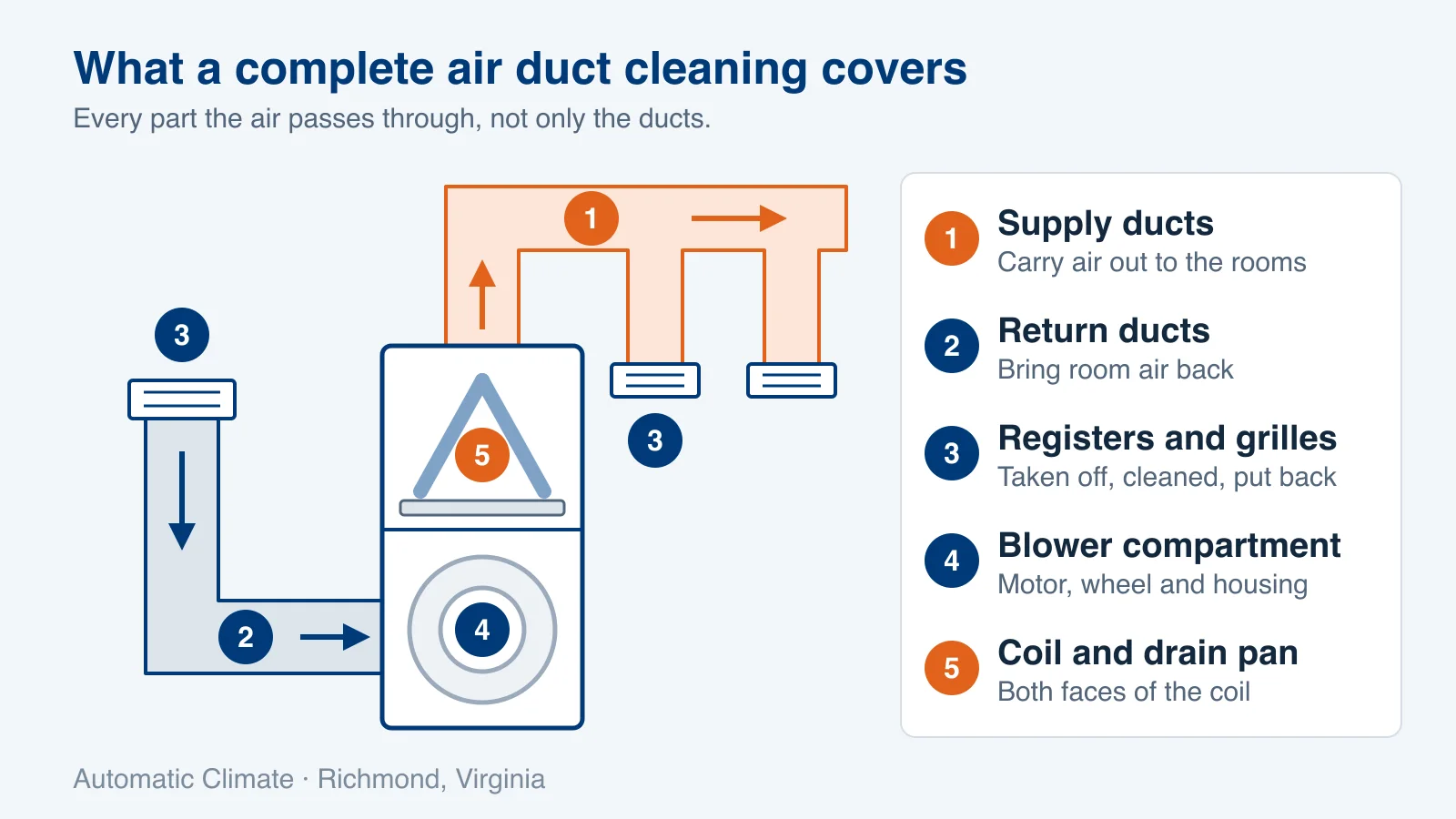
What should air duct cleaning include? Every part the air passes through, not only the ducts: the supply and return ducts, the registers and grilles, the blower, and the cooling coil with its drain pan. The dirt is brushed loose while a vacuum holds the system under suction, and you are shown the result. The US Environmental Protection Agency says duct cleaning typically costs $450 to $1,000 per heating and cooling system.
Key takeaways
- A complete cleaning covers the supply and return ducts, the registers, the blower, the coil and the drain pan.
- Get the list of parts, the method, the time and the price in writing before you compare quotes.
- Refuse routine chemical sprays, sealant coatings and steam in the ductwork.
- Have the technician show you each part, visibly clean, before the crew leaves.
- The EPA recommends duct cleaning only as needed, not on a schedule.
What should air duct cleaning include?
Air duct cleaning should include the supply ducts that carry air out to the rooms, the return ducts that bring it back, every register and grille, the blower, the cooling coil and the drain pan beneath it. A part left dirty puts dust straight back into the parts that were cleaned.
NADCA, the trade association that writes the industry’s cleaning standard, calls the name a misnomer: it is the entire heating and cooling system that should be cleaned.
The method matters as much as the list. A vacuum, truck-mounted or portable, holds the ductwork under suction for the whole job. Brushes, air whips or compressed-air tools then knock the dirt loose, so it travels to the vacuum and not into your rooms. It takes both. The EPA adds that the vacuum should exhaust outdoors, or be HEPA filtered if it exhausts inside the house.
Before the brushes come out, the technician inspects the system, opens the access doors needed to reach all of it, and covers the floors and furniture near the work. That inspection includes a check for asbestos-containing material, such as insulation or register boots. If any is found, the cleaning stops there. The EPA says such material is to be disturbed only by specially trained and equipped contractors.
How long does duct cleaning take, and what does it cost?
Duct cleaning has no standard number of hours. The time depends on the size of the house, the number of systems, how dirty they are and how many technicians come. Ask each company for its time, its price and its list of parts in writing, then compare.
Those four factors are the ones NADCA gives homeowners, and it offers no single figure for a house. If one estimate is much shorter than the others, ask which parts it leaves out.
The US Environmental Protection Agency says duct cleaning typically costs $450 to $1,000 per heating and cooling system. That is per system, so a house with two systems is two jobs. The price moves with the size of the system, how easy it is to reach and how dirty it is. The same guidance says to get written estimates from at least three companies, and a written agreement on the total cost and the scope of the job before work begins.
Then there are the mailers. NADCA tells homeowners to avoid advertisements for $99 whole house specials and other sales gimmicks. Its consumer site, Breathing Clean, says such offers often cover only limited portions of the system and can leave out the air handler, the blower, the coils, the registers or the access openings.
What should a duct cleaning not include?
A duct cleaning should not include chemical sprays, sealant coatings or steam as routine extras, and it should not come with health promises. Each one is unproven, wrong for some kinds of duct, or a way to raise the bill once the crew is in the house.
Sanitizer or biocide sprays. The EPA says research has not shown that biocides are effective in duct cleaning, and that none is registered for fiberglass duct board or fiberglass-lined duct. A company proposing one should first show you the growth it means to treat, clean the system, and show you the product label.
Sealant sprayed inside the ducts. The EPA and NADCA do not recommend the routine use of sealants to coat the inside of any type of duct. Sealing leaky joints is a different job, and a worthwhile one.
Steam or water in the ductwork. The EPA says steam cleaning and other methods involving moisture should not be used on any kind of ductwork. The coil and its drain pan are different. They are built to get wet, and NADCA’s standard has them washed where brushing is not enough.
Health promises and EPA certification. The EPA calls sweeping claims about health benefits unsubstantiated. It also certifies no duct cleaning company, so a flyer that says otherwise is wrong.
Mold you are not shown. NADCA lists being told about mold without a proper inspection as a common red flag. Ask to see it. The US Environmental Protection Agency says some microbiology laboratories can tell you whether a sample sent to them on a strip of clear sticky tape is mold.
What a duct cleaning quote is telling you
| Topic | What it usually means | What to ask |
|---|---|---|
| Lists only ducts or vents | The blower, the coil and the drain pan are probably not covered. | Which parts are included? Put the list in writing. |
| Whole-house special at a very low price | Often a limited part of the system, with extras offered on the day. | What exactly is cleaned for that price, and what costs more? |
| Adds a sanitizer, deodorizer or sealant | Not part of a typical cleaning. The EPA says such treatments are unproven in ducts. | What growth did you see, and can I read the product label? |
| Says mold was found | It has to be shown to you. Only an expert can say for certain, and that can take a lab test. | Show me where. I will send a tape sample to a lab. |
| Lists every part, the method and the time | A company that plans to clean the whole system. | Will you show me each part before and after? |
Find the quote in front of you in the first column.
How do you tell the cleaning was actually done?
Look before the crew leaves. The EPA’s test is that every part of the system is visibly clean, with no debris you can see, and it tells homeowners to have the technician show them each component when the job is finished.
Much of a duct system is out of sight, so ask at the start for pictures of the same spots before and after. Then walk the system with the technician, part by part. The table below follows the EPA’s post-cleaning checklist.
Look at the places where the crew cut into the ductwork, too. NADCA’s standard has a new access panel screwed or riveted at least every 4 inches, with the panel overlapping the duct by at least 1 inch on all sides. A panel held on with duct tape has not been closed properly.
Last, run it. The system should work in both heating and cooling before the crew packs up. If a part is not clean, the EPA’s advice is to have the company put it right before you call the job finished.
What clean looks like, part by part
| Topic | What a proper cleaning does | How you check it |
|---|---|---|
| Supply and return ducts | Dirt brushed or blown loose with the vacuum running | Look into several ducts on each side, picked at random: no visible debris |
| Registers and grilles | Taken off, cleaned and put back | Clean, and firmly reattached |
| Blower | Motor, wheel and housing cleaned | Blades clean and free of oil; no dust or debris in the compartment |
| Cooling coil | Both faces cleaned | A flashlight shines through to the other side; fins straight and evenly spaced |
| Drain pan | Cleaned and flushed | Clean, and draining when tested |
| Furnace heat exchanger | Surface cleaned | Visibly clean |
| Access openings | Closed with fitted panels | Screwed or riveted on; little or no air leaking with the system running |
The checks follow the EPA's post-cleaning checklist for homeowners.
When is duct cleaning worth doing?
Duct cleaning is worth doing when there is something to remove. The EPA does not recommend it as routine maintenance. It says to consider it when there is substantial visible mold, an infestation of rodents or insects, ducts clogged with excessive dust and debris, or dust blowing into the rooms from the supply registers.
A little dust is not on that list. The EPA says a light amount of household dust in the ducts is normal, and that a dusty return grille is normal too.
So inspect on a schedule and clean on evidence. NADCA’s standard recommends a visual inspection of a home’s air handler every year and of its supply and return ducts every 2 years. Cleaning follows when the inspection finds something to remove.
Whatever the inspection finds, fix the cause first. A roof leak, a drain pan that backs up, a filter that leaves gaps: the EPA says that unless the cause is corrected, the problem will likely come back. Duct insulation that has been wet or moldy cannot be cleaned and has to be replaced.
After that, the filter does most of the work. ENERGY STAR says to check the filter every month and to change it at least every 3 months. A clogged filter can also overheat a furnace until it shuts itself off, which our guides to the furnace reset button and the reasons a furnace does not kick on explain.
What will duct cleaning not fix?
Duct cleaning does not seal a leak, resize a duct or repair a failing blower. It removes what has collected inside the system and nothing more, so when the real complaint is a room that never gets comfortable or a high power bill, the first step is finding out why.
Leaks are a common reason. ENERGY STAR says about 20 to 30 percent of the air that moves through the duct system of a typical house is lost to leaks, holes and poorly connected ducts. A brush does nothing for that. Sealing the joints does, and it is separate work from cleaning.
Efficiency is the other. The EPA says there is little evidence that cleaning only the ducts improves a system’s efficiency, though cleaning a dirty cooling coil and blower may.
If some rooms run hot or cold, start with our guide to why a system does not distribute air evenly.
What do Richmond summers change?
Richmond summers make water, more than dust, the thing to look for. The cooling coil and its drain pan stay wet for months, and ducts in a crawl space or attic can sweat, so those are the places a cleaning here should look at hardest.
The normal July dew point at Richmond International Airport is 65 °F or higher at every hour of the day, according to NOAA’s hourly climate normals. Any surface colder than the dew point collects water, and a cooling coil is built to be one. The EPA calls condensation on or near the cooling coil a major factor in moisture contamination, and says controlling moisture is the most effective way to prevent biological growth in ducts.
Many houses around Richmond carry their ductwork through a crawl space or an attic. Cold supply ducts sweat in that air unless they are sealed and insulated, which the EPA says to make sure of in any space that is not air conditioned. So a cleaning here should include a look for wet insulation near the coil and under the house, and a test that the drain pan drains.
The EPA also says to ask a duct cleaner about state licenses. HVAC contractors in Virginia are licensed by the Board for Contractors at the Department of Professional and Occupational Regulation (DPOR), and a homeowner can look a license up on the DPOR website.
If an inspection shows there is something to remove, that is what our air duct cleaning service is for.
Frequently asked questions
How often should air ducts be cleaned?
There is no set interval. The EPA recommends cleaning only as needed and warns against companies that sell it as routine maintenance. NADCA says the answer depends on the household: smokers, pets that shed heavily, water damage, residents with allergies or asthma, and recent renovation all bring it forward. Regular inspection tells you when.
Does duct cleaning help with allergies or a dusty house?
It has not been shown to. The EPA says duct cleaning has never been shown to prevent health problems, and that much of the dirt in ducts sticks to the duct surfaces instead of entering the rooms. Cooking, cleaning and simply moving around can put more particles in the air. For symptoms you cannot explain, its advice is to talk to your doctor.
Can flexible duct or fiberglass duct board be cleaned?
Yes, gently. The EPA says only soft-bristled brushes belong on fiberglass duct board and fiberglass-lined metal duct, and that replacing accessible flexible duct can be more economical than cleaning it. NADCA's standard does not allow access holes to be cut into flexible duct. Insulated duct that has been wet or moldy is replaced, not cleaned.
Is a truck-mounted vacuum better than a portable one?
NADCA endorses neither. It says both kinds can clean a system to its standard: a truck unit is generally more powerful, and a portable one can be set closer to the ductwork. What matters more is that the vacuum runs the whole time, that anything exhausting indoors is HEPA filtered, and that the dirt is brushed or blown loose as well.
Should ducts be cleaned after a renovation or in a new house?
They should at least be inspected. Duct systems often collect a good deal of debris during construction, and NADCA's standard recommends that a new or remodeled system be verified clean before it runs. During the work, the EPA says to seal off the supply and return registers and keep the system off until the dust has been cleaned up.
What Automatic Climate checks in a duct system
A duct system is inspected before anyone decides to clean it. The inspection covers the supply and return ducts at several points, the blower compartment, both faces of the cooling coil, the drain pan and the duct insulation near the coil, and it decides whether the system needs cleaning at all. When it does, the ducts are held under suction while the dirt is brushed or blown loose, the registers and grilles come off to be cleaned, and the blower, coil and drain pan are cleaned with the ducts. Any access opening is closed with a fastened panel, and the system is run in heating and cooling before the job is called finished. Ask to be shown each part.
- Inspect the supply and return ducts, blower, coil and drain pan before recommending any cleaning
- Clean the whole system under suction, not only the duct runs
- Close every access opening with a fastened panel
- Run the system in heating and cooling before the job is called finished
Comparing duct cleaning quotes? Tell us what you have been quoted and what you are seeing at home: dust blowing from the registers, a musty smell when the air conditioner starts, or a room that never gets enough air. We start with a look at the system.
Sources
- US Environmental Protection Agency: Should you have air ducts your home cleaned
- NADCA: Proper cleaning methods
- NADCA: FAQS for homeowners flyer
- NADCA: ACR the NADCA standard edition
- ENERGY STAR: Duct sealing
- ENERGY STAR: Heating cooling
- NOAA: US climate normals
- Virginia DPOR
- NADCA's Breathing Clean: Cost time estimates
- NADCA's Breathing Clean: Avoid scams
- NADCA's Breathing Clean
This guide was prepared for Automatic Climate with AI assistance.