
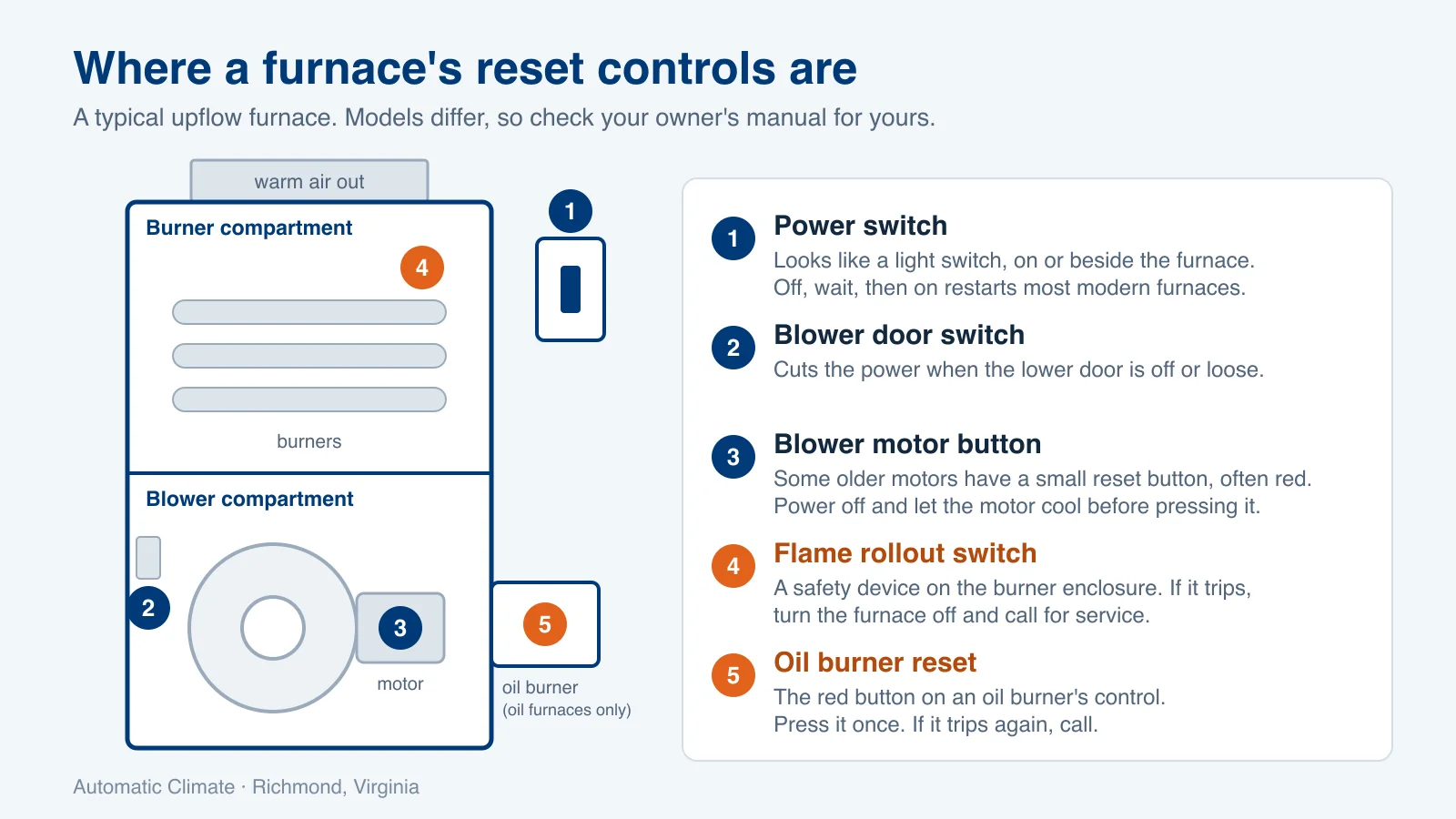
A furnace reset button is not one button. On a modern gas furnace the reset is the power switch: turn it off, wait, and turn it back on. Some older blower motors have a small reset button, often red, and an oil burner has a red button on its control that you press once. If the furnace shuts down again after one restart, stop and call for service.
Key takeaways
- On a modern gas furnace, the power switch is the reset.
- Restart once, after checking the filter and the lower door.
- Press an oil burner's red button once. If it does not stay lit, call.
- A second lockout, a gas smell or a carbon monoxide alarm means stop and call.
Where is the furnace reset button?
The reset is in a different place on each kind of furnace. Look for three things: a power switch on or beside the cabinet, a small button on the blower motor of an older furnace, and a red button on the burner control of an oil furnace.
The power switch. Almost every furnace has one, usually on the side of the cabinet or on a wall or joist within reach. It looks like a light switch and sometimes has a red cover plate. On a modern gas furnace this switch is the reset. When power returns, the control board starts over and runs its checks again.
The blower motor button. Behind the lower door, some older blower motors have a small reset button, often red, on the motor housing. It pops out when the motor overheats. Many newer motors protect themselves and come back on their own once they cool, so there is no button to find. Switch the furnace’s power off before you take that door off.
The oil burner button. An oil furnace has a red button on the control box mounted on the burner. It trips when the burner tries to light and the control sees no flame.
The lower door matters too. A switch behind it cuts the power when the door is off or not seated, so a furnace that went dead right after a filter change is often just a door that is not fully closed.
Which reset does your furnace have?
| Topic | Where it is | What to do |
|---|---|---|
| Gas furnace | Power switch on or beside the cabinet | Switch off, wait, switch on. One restart. |
| Older blower motor | Small reset button on the motor, often red, behind the lower door | Power off, let the motor cool, then press once. |
| Oil furnace | Red button on the burner's control box | Press once. If it trips again, call. |
| Heat pump or electric air handler | No button: the thermostat and the breaker | Reset the breaker once. If it trips again, leave it off. |
Find your furnace in the first column.
How do you restart a furnace safely?
Check the simple things first, then restart once. The order matters, because a restart only helps if whatever stopped the furnace has been cleared.
Set the thermostat to Heat and a few degrees above the room temperature. Then look at the filter. A clogged filter starves the furnace of air, heat builds up inside the cabinet, and a safety switch shuts the burners off. ENERGY STAR says to check the filter every month and to change it at least every 3 months.
If a light is blinking on the control board, write the pattern down first, because cutting the power can clear it. Seat the lower door, switch the power off, give the furnace a minute to shut down, and switch it back on. Then watch one full start. A small fan runs first, the burners light, and the main blower comes on a little later. If it keeps running, you are done. If it shuts down again, leave it off.
Why did the furnace lock out in the first place?
A furnace locks out because a safety control saw something wrong: no flame, too much heat, or exhaust not leaving the way it should. The reset does not fix any of those. It only lets the furnace try again.
No flame. The furnace tries to light, the flame sensor does not confirm a flame, and after a few tries the control stops and waits. Goodman’s manual for one line of gas furnaces spells it out: a lockout after three failed attempts, then an automatic retry after one hour. A dirty flame sensor is a common cause and a quick repair.
Too much heat. The high-limit switch opens when the air inside the furnace gets too hot. That is nearly always an airflow problem: a clogged filter, closed registers or a failing blower.
Exhaust or flame in the wrong place. A pressure switch stops the furnace if the vent is blocked. A flame rollout switch on the burner enclosure trips if flame or too much heat reaches it, and it stays tripped until its button is pushed. The homeowner manual from International Comfort Products says that if that switch trips a second time, turn off the furnace and call for service. We would rather hear from you the first time, because that switch does not trip without a cause.
Your owner’s manual gives the timing for your furnace, and it explains the blinking light on the control board, which is the furnace reporting which of these it saw.
When should you stop pressing reset?
Stop after one restart. On an oil furnace, press the red button once and stop if the burner does not stay lit. Do not restart at all if you smell gas, if a carbon monoxide alarm is sounding, or if you see soot or scorch marks around the burners.
On an oil burner, each press starts another attempt to light, and each failed attempt leaves unburned oil in the combustion chamber. The control is built around that risk. Beckett’s manual for its GeniSys burner control says the control goes into a restricted lockout to limit the accumulation of unburned oil, and that this lockout must be reset only by a qualified service technician. So press once. If the burner lights and stays lit, good. If it does not, call.
If you smell gas, leave the switch alone. Go outside and call the gas company or 911 from there.
If a carbon monoxide alarm sounds, do not go looking for the source. The US Consumer Product Safety Commission says to move outside to fresh air immediately and call 911 or the fire department. The same guidance says to have an alarm on every level of the home and outside sleeping areas.
Keep the space around the furnace clear as well. The National Fire Protection Association says to keep anything that can burn at least 3 feet from heating equipment, which rules out using the furnace closet for storage.
What does a Richmond winter change?
A Richmond winter changes how long you can wait. A furnace that locks out at bedtime in January has a cold night ahead of it, and resetting it over and over is how a small repair turns into a bigger one.
The normal January low at Richmond International Airport is about 29 °F, according to NOAA’s climate normals. That is cold enough for the house to be uncomfortable by morning, and the temptation is to keep pressing reset to get through the night. Do one restart. If it fails, leave the furnace off and call.
Homes around Richmond are a mix. Many have a gas furnace, many have a heat pump with electric backup, and some older houses still heat with oil. On a heat pump there is no reset button to find. Our guide to resetting a Trane system covers that, and if the furnace will not start at all, see the reasons a furnace does not kick on.
When a furnace has locked out twice, it needs heating repair, not a third try.
Frequently asked questions
Is it safe to reset a furnace more than once?
One restart is reasonable once you have checked the filter and the door. A second lockout means a safety control is seeing a real fault, and each reset after that runs the furnace against it. On an oil furnace, press the red button once. If the burner does not stay lit, stop, because each failed try leaves unburned oil in the chamber.
Why does my furnace start and then shut off after a few seconds?
The burners light and go out again when the control cannot confirm the flame. The usual cause is a flame sensor coated with residue, which a technician cleans or replaces. A weak igniter, low gas pressure or a blocked vent can look the same from the hallway, so the fault code matters.
Does a heat pump or electric furnace have a reset button?
Usually not. A heat pump and its indoor air handler are restarted at the thermostat or the breaker, and a breaker that trips a second time should stay off until someone has looked at it. Some outdoor units have a pressure reset behind a service panel, which is for a technician.
What does the blinking light on my furnace mean?
It is a fault code. The control board flashes a pattern that stands for what it saw before it shut down, and the key is printed inside the furnace door or in the owner's manual. Write the pattern down before you switch the power off, and have it ready when you call.
What Automatic Climate checks when a furnace keeps shutting down
A furnace that locks out twice has told you something specific, and our job is to read it. We start with the fault code on the control board, then test the parts it points to: the flame sensor and igniter, the pressure switch and vent, the high-limit switch and the airflow behind it. We measure the temperature rise across the furnace against the range on its nameplate, and check the gas pressure and the burner flame.
- Read the fault code and the control board's fault history
- Test the flame sensor, igniter and pressure switch
- Measure temperature rise and airflow to find what is overheating the furnace
- Check gas pressure, the burner flame and the heat exchanger
Furnace locked out again? Leave it off and tell us what you saw: the blinking pattern on the control board, what the furnace did before it stopped, and anything you smelled or heard. We will take it from there.
Sources
This guide was prepared for Automatic Climate with AI assistance.