
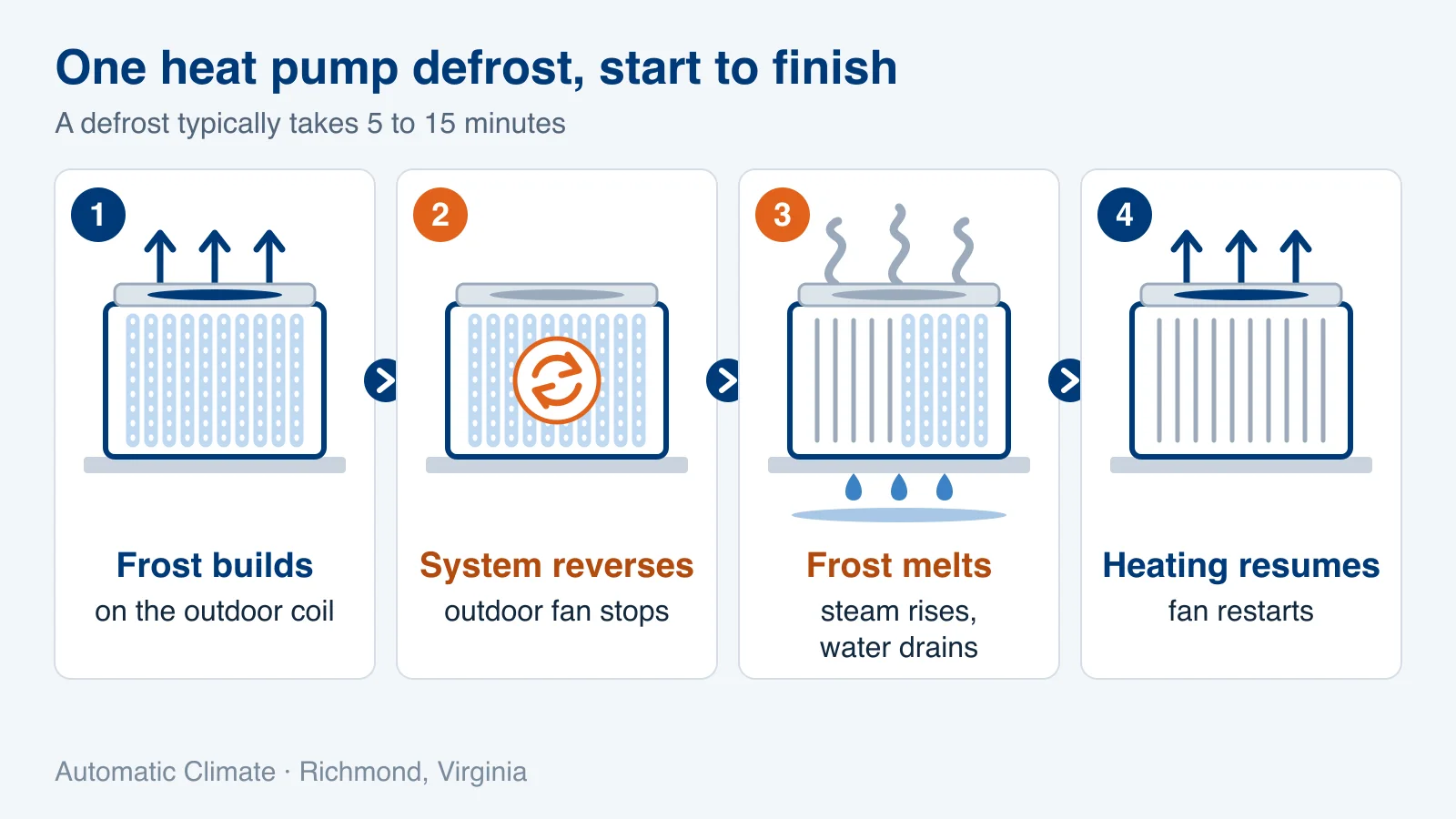
A heat pump defrost cycle is the system melting frost off its outdoor coil. The heat pump runs in reverse for a few minutes, the outdoor fan stops, and steam rises from the unit. A defrost typically takes 5 to 15 minutes, according to an owner guide published by the US Department of Energy. A defrost that keeps running, repeats back to back, or leaves the outdoor unit iced over is stuck, and that takes a technician.
Key takeaways
- A defrost typically takes 5 to 15 minutes.
- Steam, a stopped outdoor fan and water at the base are normal.
- A defrost that will not end, repeats back to back, or leaves the unit iced over needs a technician.
- Clear leaves and snow. Never chip ice or pour hot water on the unit.
What is a heat pump defrost cycle?
A heat pump defrost cycle is a short, automatic reversal that melts frost off the outdoor coil. In heating mode the coil runs colder than the outdoor air, moisture freezes on it, and the frost blocks the airflow the heat pump depends on.
Frost forms on the outdoor coil when it drops below 32°F, according to the US Department of Energy guide, which the Consortium for Energy Efficiency wrote. The air can be warmer than that. Payne’s owner’s manual says moisture may begin to freeze on the coil once the outdoor temperature drops below forty-five degrees.
To clear the frost, the control shifts the reversing valve and runs the system as an air conditioner for a few minutes, sending hot refrigerant to the outdoor coil. The outdoor fan stops so the coil warms quickly, and on a ducted system the backup heat can come on to cover the gap indoors. When a sensor on the coil reads warm enough, the valve shifts back and heating resumes.
How long should a defrost last, and how often should it run?
A defrost should be over in minutes, and on timed equipment the next one is at least half an hour of heating away. The control enforces both limits: a sensor or a timer ends each defrost, and a timer or a second sensor decides when the next one starts.
A defrost typically takes 5 to 15 minutes, according to the US Department of Energy guide. The equipment sets a limit of its own: Payne’s manual says its heat pump returns to heating once the ice has melted, or after a maximum of ten minutes.
A time-and-temperature control checks the coil on a timer: Goodman’s installation manual gives settings of thirty, sixty or ninety minutes, and Payne’s says a defrost starts at the set time only if there is enough ice to interfere with heating. A demand control watches temperatures instead. Trane’s service sheet for one such control lists the conditions: outdoor air below forty-nine degrees, the coil below thirty-five, and the gap between the two growing.
A Richmond winter keeps a heat pump in frost range most nights. Richmond averages about 20 days in January with a low of 32°F or colder, according to NOAA’s climate normals for Richmond International Airport. Damp air frosts a coil faster than dry air, so expect more defrosts on a drizzly night than on a clear one.
What does a normal defrost look and sound like?
A normal defrost looks alarming and is over quickly. The outdoor fan stops, the unit gives a whoosh as the refrigerant changes direction, steam rolls off the coil, and water runs out of the base. Then the fan restarts and the heat comes back.
The steam is meltwater turning to mist in the cold air, and Payne’s manual tells owners not to be alarmed by it. The water is the melted frost, and the US Department of Energy guide warns against letting it pool and refreeze on a walkway.
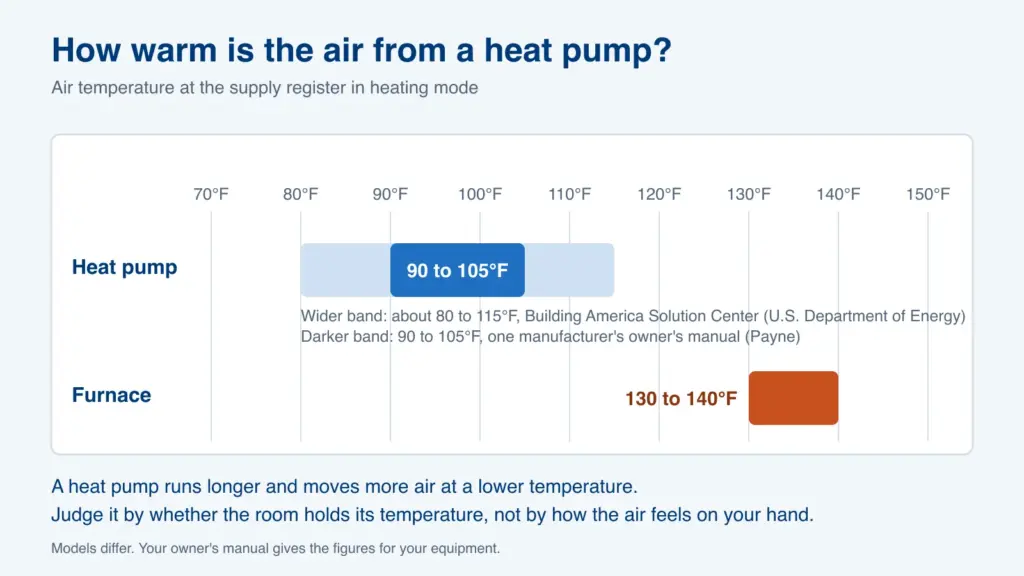
Indoors, the air from the registers runs cooler for those minutes and the thermostat may show auxiliary heat. If the cool air is your real question, see heat pump blowing cool air in heating mode.
After a good defrost the fins are bare, wet metal and the fan is running. Steam has no smell. A burning smell, or smoke that carries on after the fan restarts, is something else: turn the system off and call.
How do you know a defrost is stuck?
A defrost is stuck when it does not end, when one follows another with almost no heating in between, or when the outdoor unit is still iced over afterwards. Each one points to a part that can be tested.
A defrost that does not end. Past the typical range, with the outdoor fan still stopped and the house cooling off, the heat pump is stuck in reverse: the reversing valve has not shifted back, or the control board has not released it.
One defrost after another. A control that calls for defrost again and again, with little heating in between, is reading the coil wrong or reacting to a real fault. Trane’s service sheet sends the technician to the two temperature sensors first, then to the refrigerant charge, the outdoor fan and the reversing valve.
An outdoor unit that stays iced over. Frost that thickens into solid ice, or a coil still white after the steam stops, means defrosts are not starting or not finishing: a failed sensor or board, an outdoor fan that is not running, a low refrigerant charge, or leaves and snow blocking the coil.
Ice on top after freezing rain. A glaze on the top grille is weather, and a defrost cannot melt it: the cycle heats the coil, not the cabinet. Richmond gets that weather: the National Weather Service listed 0.29 inch of freezing rain at Richmond International Airport in one February ice storm. Payne’s manual calls ice on the grille normal in that weather and says to leave it: it clears within a few days.
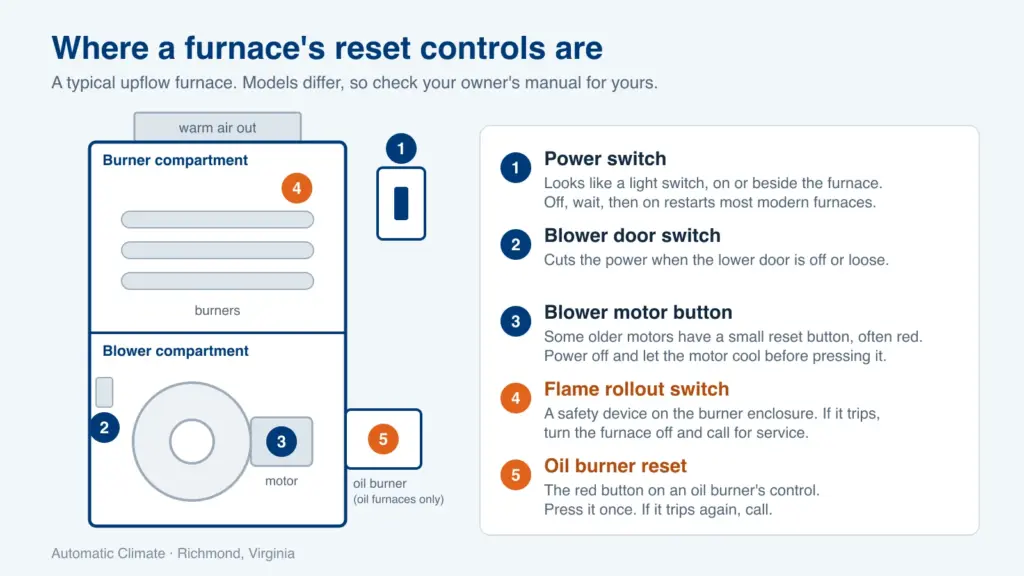
For the first three, or when ice has sealed the sides of the coil, set the thermostat to Emergency Heat, which heats the house on the backup heater and rests the heat pump, and call for heating repair. If that backup is a furnace that will not start, see where the furnace reset button is.
Normal defrost or stuck defrost?
| Topic | What it means | What to do |
|---|---|---|
| Steam and a stopped outdoor fan for a few minutes | A normal defrost | Nothing. The heat comes back without help. |
| Water running from the base, or a puddle | Meltwater from the coil | Keep the base draining. Watch for ice on walkways. |
| A defrost that goes on well past the typical range | The reversing valve or the control has not let go | Switch to Emergency Heat and call. |
| One defrost right after another | A sensor, the outdoor fan or the refrigerant charge | Note how often it happens, then call. |
| Coil still white, or the unit encased in ice | Defrosts are not starting or not finishing | Switch to Emergency Heat and call. Do not chip the ice. |
| Ice on the top grille after freezing rain | Weather, and the defrost cannot reach it | Leave it alone. Call if the sides of the coil are sealed too. |
Find what you are seeing in the first column.
What can you do yourself, and what should you leave alone?
Keep air and water moving around the outdoor unit, and leave the ice alone. A homeowner’s part is clearing leaves and snow and keeping the meltwater draining away.
Clear leaves and mulch from around the unit and brush loose snow off it. Payne’s manual says not to let debris build up around or on top of the unit, and not to cover it. Keep the gap under the unit open: Goodman’s manual notes that the base has cutouts under the coil so defrost water can drain. If a gutter drips on the unit, fix the gutter. The US Department of Energy guide says to shield a heat pump from water and snow coming off the roof.
Do not chip or pry at ice: the fins bend, and the tubing behind them holds refrigerant. Do not pour hot water over the unit, because it refreezes in the base where the meltwater has to get out. Do not switch the power off and on to end a defrost: Payne’s manual warns that controlling the system that way may damage the unit. If the outdoor unit’s breaker trips, reset it once, and if it trips again leave it off and call.
Frequently asked questions
Does a heat pump defrost in summer?
No. Defrost runs only in heating mode, when the outdoor coil is the cold one. In cooling mode the cold coil is indoors, and ice on it or on the larger refrigerant line outside points to weak airflow or a low refrigerant charge. Turn the system off, let it thaw, check the filter, and call if the ice comes back.
Why is there a puddle or a patch of ice under my heat pump?
A puddle under a heat pump in winter is meltwater from defrost. Each cycle turns the frost on the coil into water that drains out through the base, and on a cold night it freezes where it lands. That is expected. A mound of ice growing up into the bottom of the coil means the water is not draining away, and it needs attention.
Should I turn the heat pump off while it defrosts?
No. Leave the thermostat alone and let the control finish the defrost. The cycle ends when the coil is warm or the control’s time limit runs out, and shutting the system off partway leaves frost on the coil for the next run. If a defrost is plainly stuck, switch the thermostat to Emergency Heat instead of cutting the power.
Do ductless mini-split heat pumps defrost too?
Yes. A ductless heat pump frosts and defrosts the same way, with one difference indoors. The US Department of Energy owner guide notes that the indoor unit of a ductless system may give off some cooling while the outdoor coil is heated. The warm air returns when the cycle ends, without anyone touching the remote.
Does defrosting run up the electric bill?
A normal defrost is brief and part of a heat pump’s ordinary running. Trouble shows up as a pattern: a heat pump that defrosts constantly, or a thermostat that shows auxiliary heat all the time, is leaning on the backup heater. The US Department of Energy owner guide calls a sudden rise in electricity use the most common sign that a heat pump is not working properly.
What Automatic Climate checks when a defrost will not end
A stuck defrost has a short list of causes, and we test them in order. We start at the outdoor coil, because where the ice sits narrows the list. Next is the defrost sensor: whether it is mounted where the maker put it, and whether its resistance on an ohmmeter matches the maker's chart for the temperature it is sitting at. Then we force a defrost from the control board and time it, watching the reversing valve shift, the outdoor fan stop and the cycle end on temperature instead of on the time limit. A clamp meter on the heater circuit shows the backup heat coming on. If the control and the valve pass, we connect gauges and line-temperature clamps to check the refrigerant charge, test the outdoor fan motor and its capacitor, and check the airflow through both coils.
- Read the ice pattern on the outdoor coil
- Test the defrost sensor against the maker's resistance chart, and check where it is mounted
- Force a defrost and time it: valve shifts, fan stops, cycle ends on temperature
- Check the refrigerant charge with gauges and line temperatures
- Test the outdoor fan motor and its capacitor
- Check airflow through both coils and the drain path under the unit
Defrost that will not quit? Switch the thermostat to Emergency Heat and tell us what you saw: how long the defrost ran, how soon the next one started, and where the ice is on the outdoor unit. A photo of the unit helps. We will take it from there.
Sources
This guide was prepared for Automatic Climate with AI assistance.