


Uneven heating and cooling means some rooms are not getting their share of the air. ENERGY STAR says that in a typical house about 20 to 30 percent of the air that moves through the duct system is lost due to leaks, holes and poorly connected ducts. Start with the filter, the registers, the return grilles and the doors. If rooms still run hot or cold, the cause is in the ducts, the equipment or the room itself.
- ENERGY STAR says that in a typical house about 20 to 30 percent of the air that moves through the duct system is lost due to leaks, holes and poorly connected ducts ENERGY STAR
- ENERGY STAR says airflow problems can reduce a system’s efficiency by up to 15 percent ENERGY STAR
- The normal January low at Richmond International Airport is about 29 °F NOAA
- Pacific Northwest National Laboratory says a typical door undercut of 1/2 to 3/4 inch is not enough on its own to let that air back out, especially over carpet Pacific Northwest National Laboratory
Key takeaways
- Check the filter, the registers, the return grilles and the bedroom doors before anything else.
- Keep every register open. Too many closed dampers starve the furnace or air handler of air.
- Ducts in an attic or crawl space are the first place to look for lost air.
- A hot upstairs in summer is a balance problem: the second floor needs more of the air in cooling season than in heating season.
- Ice on the refrigerant line, a burning smell or a breaker that trips twice means switch the system off and call.
What causes uneven heating and cooling in a house?
Three things cause uneven heating and cooling in a house: air that is blocked on its way to a room, air that leaks out of the ducts before it gets there, and rooms that gain or lose heat faster than the rest of the house. You can check the first. The other two take measurements.
Most central systems have one thermostat, and it only knows the temperature where it hangs. When that spot reaches the setting, the system stops, whether or not the back bedroom has caught up. If the reading itself looks wrong, start with our guide to a thermostat that is not reading the correct temperature.
In the heating season the cold rooms are usually at the end of a long duct run, over a crawl space or over a garage. In summer the trouble moves upstairs, to the rooms under the roof and on the sunny side. Write down which rooms are off, in which season and at what time of day. A technician will ask for that list.
Which pattern does your house have?
| What you notice | What it usually points to | What to do |
|---|---|---|
| One room, and the rest of the house is fine | A blocked register, a closed damper or a crushed or disconnected duct to that room | Clear the register. If the air is still weak, have that duct run inspected. |
| Upstairs too hot in summer | Rising heat, the attic overhead and a thermostat downstairs | Have the system balanced for the season and the attic insulation checked. |
| Fine with the door open, stuffy with it shut | No path for the air to get back to the return | A transfer grille, a jump duct or a return for that room |
| Weak air at every register | A clogged filter, a failing blower, or a dirty or iced indoor coil | Change the filter. If there is ice, switch the cooling off and call. |
| Rooms at the far end or over the garage | Leaks and kinks along a long duct run, and more surface facing outdoors | A duct leakage test, then sealing and insulation |
| Every room swings and the system starts and stops often | Equipment too large for the house | A load calculation before the next replacement |
Find your house in the first column.
What can you check yourself before you call?
Check four things: the filter, the registers and return grilles, the fan setting on the thermostat, and the bedroom doors. All four are safe for a homeowner and cost nothing but a filter. Anything inside the air handler or the ducts is a job for a technician.
The filter. ENERGY STAR says to check the filter every month and to change it at least every 3 months. A dirty filter slows the air through the whole system, and the rooms that were already short of air show it first.
Registers and returns. Open every supply register and move furniture, rugs and curtains off them. Clear the return grilles too, the larger grilles that pull air back to the system. A sofa against a return starves every room at once. Leave the registers open in rooms you don’t use. Pacific Northwest National Laboratory warns that too many closed dampers leave too little air moving through the furnace or air handler, and that in cooling season the indoor coil can ice up.
The fan setting. Set the thermostat fan to Auto, as the US Department of Energy advises in its cooling tips. On the On setting the blower runs between heating cycles, so the registers blow unheated air part of the time. That is easy to mistake for weak heat.
The doors. A register can only push air into a room if the air already there can get out. In a bedroom with no return grille of its own, the way out with the door shut is the gap under it. Pacific Northwest National Laboratory says a typical door undercut of 1/2 to 3/4 inch is not enough on its own to let that air back out, especially over carpet. Leave the door of the problem room open for a day. If the room evens out, it needs a path back to the return, which is a duct repair.
A sofa against a return starves every room at once.
Four checks before you call
- Filter Look at it every month in heating and cooling season and change it when it looks dirty.
- Registers and returns Open every register. Move furniture, rugs and curtains away from the registers and the return grilles.
- Fan setting Set the thermostat fan to Auto.
- Doors Leave the door of the problem room open for a day and see whether the room evens out.
All four are safe for a homeowner.
Why is the upstairs hotter than the downstairs?
The upstairs runs hotter because warm air rises, the roof and attic sit right above the bedrooms, and the thermostat is usually downstairs. In summer the second floor needs a bigger share of the air than it needed in winter.
Many two-story houses around Richmond have one system and one thermostat in the downstairs hall. The normal July high at Richmond International Airport is about 90 °F, according to NOAA’s climate normals. On an afternoon like that the bedrooms under the attic take the most heat, and the thermostat sits in the coolest part of the house. The system shuts off when the hall is comfortable.
Where one trunk duct serves each floor, dampers in the trunks let a technician move air from one floor to the other. Pacific Northwest National Laboratory calls that a common solution for two-story houses, and describes the seasonal setting: less air upstairs during the heating season and more air upstairs during the cooling season.
In the heating season the upstairs is still the warmer floor, because the heat rises into it, and the complaint moves downstairs. Dampers that were set once and never touched suit one season at best.
How do leaky or crushed ducts cause hot and cold rooms?
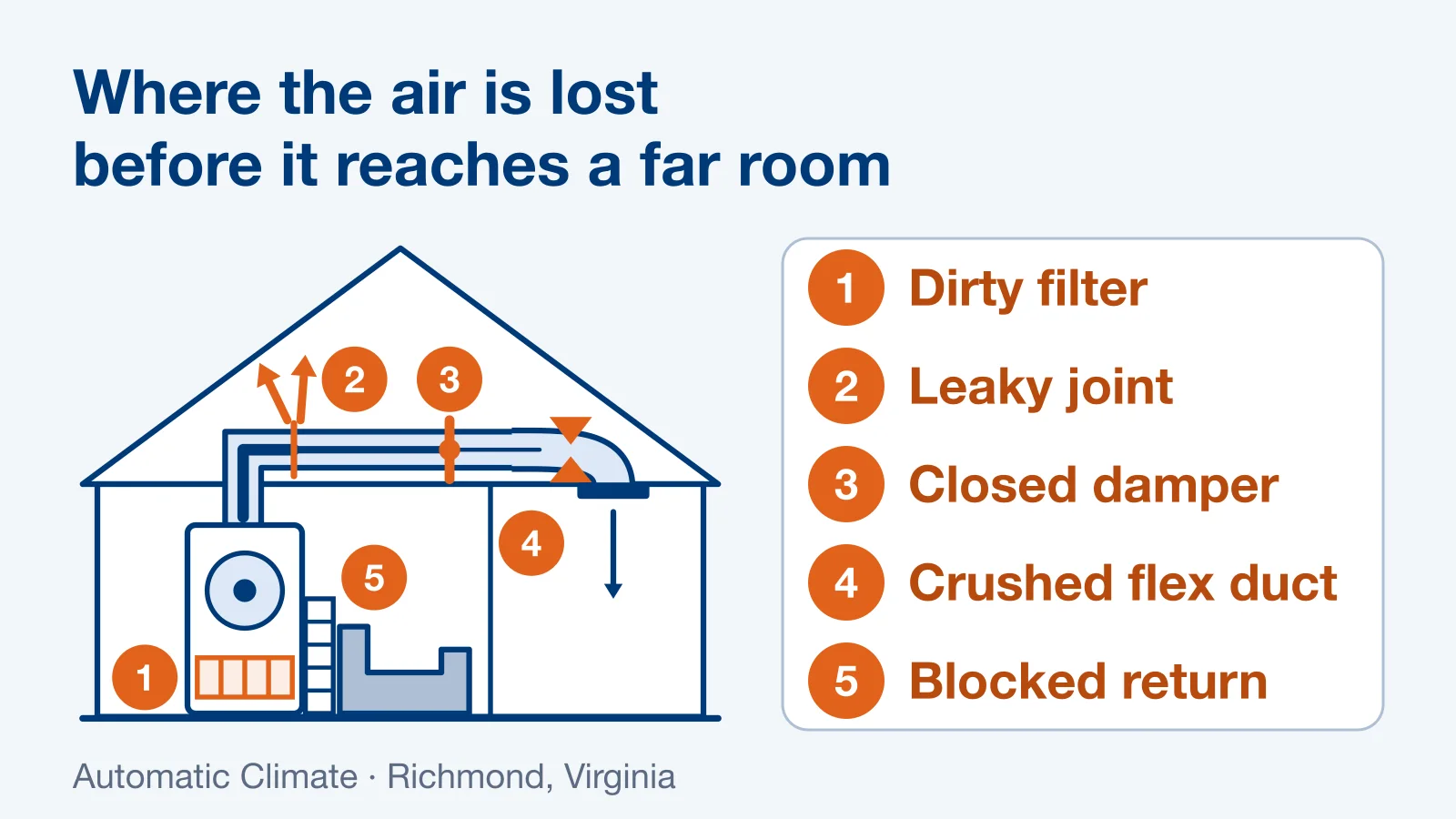
A leak in a supply duct spills heated or cooled air into the attic or crawl space before the air reaches the room, and a crushed or kinked flexible duct chokes off what is left. The rooms at the far end of the run get the smallest share, so those rooms run hot or cold.
ENERGY STAR lists the signs of poorly performing ducts: rooms that are difficult to heat and cool, ducts located in an attic, crawl space or garage, and tangled or kinked flexible ducts. A lot of houses around Richmond match the second sign, with ducts in a vented crawl space, in the attic, or both.
Those spaces follow the weather, not the thermostat. The normal January low at Richmond International Airport is about 29 °F, according to NOAA’s climate normals. Warm air that escapes from a loose joint on a night like that heats the crawl space instead of the bedroom. Leaks on the return side work the other way: the US Department of Energy notes that unconditioned air can be drawn into return ducts through unsealed joints.
A duct that has come apart completely looks different: one room with almost no air at the register while the rest of the house is fine. Flexible duct, often called flex, gets flattened under stored boxes, or sags between its supports until the air has to squeeze through a kink. A damper that is closed or stuck shuts off part of the duct the same way.
What does weak airflow at every register mean?
Weak airflow at every register points to the equipment, not to one duct. The usual causes are a clogged filter, a blower that is dirty or failing, and an indoor coil that is dirty or, in cooling season, iced over.
If a clean filter changes nothing, the blower and the coil are next, and both are inside the air handler. ENERGY STAR says airflow problems can reduce a system’s efficiency by up to 15 percent. Checking the blower components is part of a yearly tune-up.
In summer, look at the larger copper line at the outdoor unit. Ice on that line means the indoor coil is icing over, and an iced coil blocks the air to every register. Switch the cooling off and call. A dirty filter or low refrigerant is the usual cause, and low refrigerant means a leak. Pacific Northwest National Laboratory tells technicians to locate and fix the leak, not just top the system off.
A burning smell at the registers or a breaker that trips twice is also a reason to switch the system off and call.
The wrong size of system shows up as uneven rooms too. ENERGY STAR says a system that is too large will not keep a home comfortable because of frequent on and off cycling. Short cycles end before the far rooms get their share, and in a humid Richmond summer they end before the air conditioner has pulled much moisture out of the air.
Air from a heat pump that simply feels cooler than furnace air is a different matter, covered in our guide to a heat pump blowing cool air. So is a furnace that will not start at all: see the reasons a furnace does not kick on.
When is the house the problem and not the HVAC system?
The house is the problem when the air reaching a room is fine but the room gains or loses heat faster than its neighbors. Thin attic insulation, air leaks, a wall of west-facing glass and a floor over a garage or crawl space all do that, and no duct repair makes up for them.
The ENERGY STAR heating and cooling guide puts it plainly: when some rooms are too hot or cold, inadequate air sealing or insufficient insulation could be the cause.
You can tell the two apart with your hand. If the register in the problem room blows as hard as the others and the room still drifts, look at the room: attic insulation that is thin or pushed aside, a draft at the window or the attic hatch, or sun on the glass all afternoon.
For the sunny side, the US Department of Energy says to keep the window coverings closed during summer days. A room over a vented crawl space with a cold floor in January needs insulation and air sealing under the floor, not more heat from the register.
What fixes uneven airflow, and what does each fix do?
Four repairs deal with uneven airflow. Sealing and insulating the ducts puts the lost air back, balancing shares it out, a return path lets it circulate, and zoning gives each area its own thermostat. Automatic Climate measures first, because each one solves a different problem.
Sealing and insulating ducts. Joints are sealed with mastic or metal tape, never cloth duct tape, and ducts in the attic or crawl space are wrapped in insulation. The Pacific Northwest National Laboratory checklist for duct sealing gives a preferred target for duct leakage of 10% or less of total air flow, with one leakage test before the work and another after.
Balancing. A technician measures the air at each register and adjusts the dampers in the branch ducts a little at a time, taking air from the comfortable rooms and giving it to the uncomfortable ones. Pacific Northwest National Laboratory is clear about the limit: dampers fine-tune the airflow, and they do not correct a duct that is the wrong size.
Adding a return path. ENERGY STAR notes that many systems have return ducts that are too small. The repair is a larger return or a second one. For a bedroom that goes stuffy with the door shut, the Pacific Northwest National Laboratory checklist calls for a transfer grille or a jump duct where the pressure difference across a closed bedroom door is 5 Pascals or more.
Zoning. Motorized dampers in the ducts and a thermostat for each zone send air where the house calls for it. Zoning has to be designed around the ducts and equipment already there.
A system that is the wrong size is settled at replacement, with a load calculation for the house.
Frequently asked questions
Should I close the vents in rooms I don't use?
Not as a way to push air somewhere else. The dampers in registers are for small adjustments. Pacific Northwest National Laboratory warns that too many closed dampers leave too little air moving through the furnace or air handler, and that in cooling season the indoor coil can ice up. Leave the registers open and have the system balanced at the duct dampers.
Will a bigger furnace or air conditioner fix a room that never gets comfortable?
Usually not. If the air is not reaching the room, a larger unit pushes more air into the same leaky or undersized ducts. ENERGY STAR says to deal with the big air leaks in the house and the duct system before investing in new equipment, because those are sometimes the real source of the problem. A unit that is too large also cycles on and off more often.
Can I seal my own ducts?
You can seal the joints you can reach. ENERGY STAR says to use mastic sealant or metal tape, never duct tape, and to insulate the ducts you can reach in the attic, crawl space or garage. Then have a professional check the balance. The US Department of Energy adds that duct sealing should be tested by a qualified professional for combustion safety and proper airflow.
Why is the room over the garage always the hottest or the coldest?
A room over a garage usually has more surface facing the outdoors than the rooms around it: outside walls, a roof above and an unheated garage below. The room also tends to sit at the end of the longest duct run, so it needs the most air and gets the least. Insulation and air sealing come first, then the duct, and sometimes a separate ductless unit.
Will a ceiling fan fix a hot room?
A ceiling fan makes people feel cooler while the room stays the same temperature. The US Department of Energy describes the effect as wind chill and says to turn the fan off when you leave the room. In winter, reverse the fan to run clockwise so it pushes the warm air at the ceiling back down. The cause of the hot room still has to be found.
What Automatic Climate checks when rooms heat and cool unevenly
We start where you did, with the filter, the registers and the returns, and then we measure. A manometer across the air handler gives the static pressure, which shows whether the blower is pushing against a restriction. Thermometers in the return and the supply give the temperature rise in heating or the drop in cooling. Then we measure the airflow at the registers and compare the weak rooms with the strong ones. Last comes the part most people never see: we follow the ducts through the attic and the crawl space, looking for open joints, crushed flexible duct and dampers that are shut or stuck.
- Measure static pressure across the air handler with a manometer
- Measure the temperature rise or drop between the return and the supply
- Measure the airflow at the registers, room by room
- Inspect the ducts in the attic and crawl space for open joints, crushed flexible duct and stuck dampers
- Check the blower, the indoor coil and, in cooling season, the refrigerant charge
- Explain whether the remedy is a duct repair, sealing, balancing, a return path or zoning
Rooms that never match the thermostat?
Tell us which rooms run hot or cold, in which season and at what time of day, and whether the ducts are in the attic or the crawl space. We will measure the airflow and show you where the air is going.
Sources
- ENERGY STAR: Duct sealing
- ENERGY STAR: Heating cooling
- ENERGY STAR: Maintenance checklist
- ENERGY STAR: Heating cooling guide
- ENERGY STAR: Duct sealing flyer
- US Department of Energy: Energy saver guide
- Pacific Northwest National Laboratory: Pressure balancing supply and return ducts existing homes
- Pacific Northwest National Laboratory: Ducted returns
- Pacific Northwest National Laboratory: Duct sealing and insulation
- Pacific Northwest National Laboratory: Pre retrofit assessment existing HVAC systems
- NOAA: US climate normals
This guide was prepared for Automatic Climate with AI assistance.
CURRENT PROMOTIONS